Alex Freeman: How U.S. Soccer Star's Father, Packers' Antonio Freeman, Found Football
For Freeman father and son, seizing the moment when opportunity presents itself has always come naturally. There is only ready, never not.

THERE’S A SPECIAL box where Antonio Freeman keeps cherished belongings commemorating extraordinary athletic achievements. A year ago, only a few items were stored; now, an assortment of red, white, and blue stripes, rich purples, and submarine yellows compete for space. The palette, however, is not an ode to his nine-year NFL career — which includes a Super Bowl, an All-Pro nod, and induction into the Green Bay Packers Hall of Fame — but to a father’s unabashed pride.
Alex Freeman, Antonio’s son, has skyrocketed from Major League Soccer academy starlet to World Cup starter in the blink of an eye.
“Man, it’s been so quick,” Antonio says, his astonishment percolating through the phone. “He was No. 2, then was No. 22, and then he was No. 30. I’ve got all these [club] jerseys, and now I’ve got all these U.S. jerseys, and, now, I’ve got a Villarreal jersey, and he’s only 21 [years old].”
Alex has distinguished himself from his father’s shadow, overcoming early disappointment to embark on his own path to superstardom. His whirlwind ascent will presently culminate in starting at right back for the United States Men’s National Team at the 2026 FIFA World Cup.
Antonio will be in attendance at Los Angeles’ SoFi Stadium when the USMNT open group-stage play against Paraguay on Friday night. He hopes catching Alex’s World Cup debut will go more smoothly than his trek to Alex’s first professional start for Orlando City SC last March.
The three-hour drive up from south Florida’s Fort Lauderdale to Orlando went smoothly — until Antonio missed an exit. Thirty minutes before kickoff, he parked and walked up to the stadium. But, that’s when he realized he’d headed into the Citrus Bowl, which was bustling with a car show; Orlando City’s Inter&Co Stadium is a 25-minute, mile-long walk away. Antonio had already parked.
“I started running,” Antonio recalls. “I said, ‘Oh, man, I can’t run. I’m out of shape.’ Then I started walking fast, and then I saw those little scooters that you get on.”
He tried scanning the scooters over and over and over again. Nothing. Fifteen minutes until kickoff. He tried calling an Uber. No dice. He conceded and just speed-walked the rest of the way.
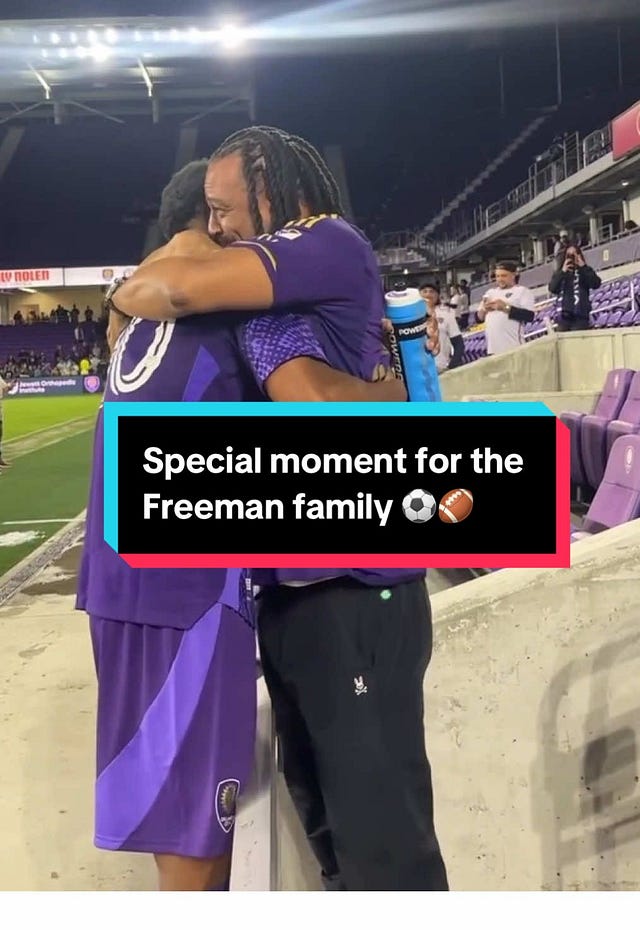
Pouring sweat, Antonio finally reached the correct stadium — three minutes of the game had already passed. He’d missed the player intros and the chance to hear the crowd roar as his son’s name was announced in the starting XI. A little bummed, Antonio settled into his seat and did what any proud dad would do: He pulled out his phone and started filming.
Then it happened. In the 35th minute, Alex got behind the Toronto FC defense. He slotted a low shot past Toronto’s keeper, scoring his first MLS goal in his first start. As he slid into a celebration, Antonio went wild in the stands.
 Tiktok failed to load.
Enable 3rd party cookies or use another browser
“I was there for the magic,” Antonio says. “Maybe not the magical moment [of player intros], but I was there for the magic.”
One season as a regular starter for Orlando City was all Alex needed. He’s now a USMNT regular — the youngest member of the World Cup squad — and, in late January, completed a transfer to La Liga’s Villarreal CF. The top-flight Spanish club will compete in Champions League next season.
“Take your chances,” Alex told FOX 35 Orlando’s Aaron Page ahead of his Villarreal move. “You don’t know when it’s gonna come next or when somebody is gonna come and steal it. As a young pro, when you get the chance, you’ve gotta take it and be able to give 100%.”
For Freeman father and son, seizing the moment when opportunity presents itself has always come naturally. There is only ready, never not.
A BASKETBALL TOWN
ANTONIO FREEMAN STOOD on the side of the road. It was a late August night in 2004, and his Toyota Land Cruiser had stalled just two miles from his house in Baltimore County.
Irritating, but the transmission leak didn’t completely spoil his mood. His son, Alexander, had just been born.
Earlier that day, the NFL preseason had also just kicked off. Freeman, 32, was unsigned, but just over a week later, agreed to a one-year contract with the Miami Dolphins. Until that point, he’d spent his entire nine-year career with Mike Holmgren and Mike Sherman’s Packers and, for one year, Andy Reid’s Philadelphia Eagles, who employed West Coast-style offenses. As if age wasn’t a concern, adjusting to a new system weeks before the season started, after a decade of a scheme he was familiar with, proved too daunting a mountain to climb.
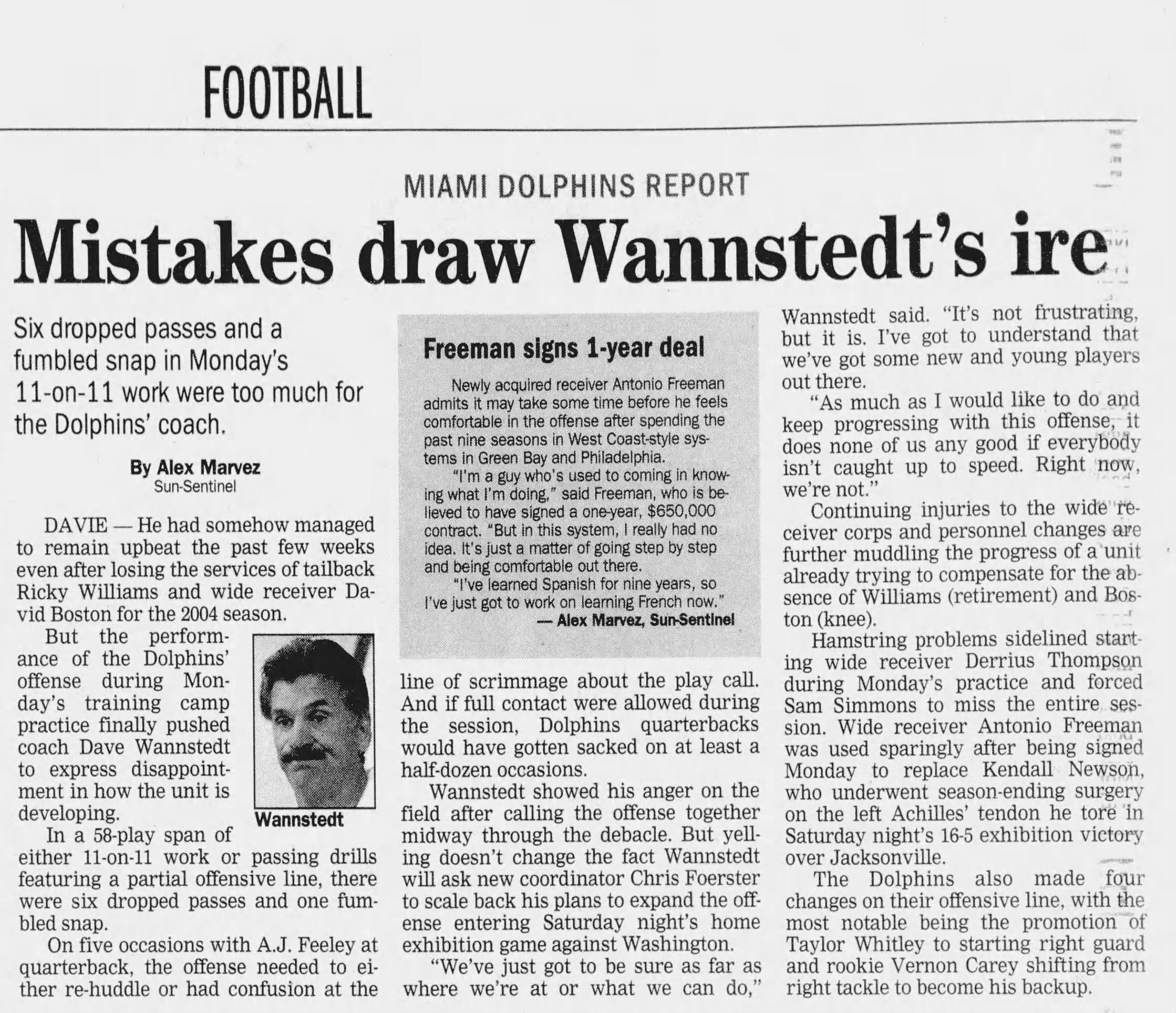
“I’ve learned Spanish for nine years, so I’ve just got to work on learning French now,” Freeman quipped to the Miami Sun-Sentinel at the time. The Dolphins ultimately released him before the regular season, unofficially marking the end of his NFL career. But perhaps learning French is overrated when you can already speak the language of Super Bowl Champion.
Freeman finished his NFL career with 477 catches for 7,251 yards and 61 touchdowns. He caught 10 career postseason touchdowns, including three in two Super Bowls. He lifted a Lombardi Trophy. He spent eight of his nine seasons with the Packers, leading the iconic franchise in receiving from 1996-1999. He also led the NFL with 1,424 receiving yards in 1998.
Many football fans best remember him for one of the greatest catches in NFL history, his bobbled walk-off score dubbed the “Monday Night Miracle.” (“He did WHAT?!”) Packers fans might argue that his then-record-setting 81-yard touchdown catch in Super Bowl XXXI was even sweeter. (Editor’s note: Sadly, the NFL has done everything in its power to prevent you from posting videos on Substack.)
In 2009, the Packers inducted Freeman into their Hall of Fame. Not bad at all for a former third-round pick, the ninth receiver chosen in the 1995 NFL Draft, yet the only one to ever earn First-Team All-Pro honors.
In another universe, though, Freeman wouldn’t be dunking footballs through a field-goal post as he celebrates a Super Bowl touchdown. He’d be dunking a basketball through a hoop in the NBA Finals.
Freeman is an East Baltimore native.
“Baltimore,” he says, “is a basketball town.”
He proudly references a couple Charm City high school powerhouses. Dunbar. Southern. Lake Clifton. He rattles off legends and standout contemporaries. Sam Cassell, his “summer basketball coach.” Muggsy Bogues. Reggie Williams. David Wingate. Calvin and Pat Williams. Donta Bright. Michael Lloyd.
“Those guys were around,” Freeman says. “So we dreamt basketball.”
Freeman, who attended Baltimore Polytechnic Institute (b.k.a. “Poly”), belonged among that collection of stars, even if his didn’t burn brightest of them all. A 6-foot-1 guard, he was capable of scoring at a very respectable volume.


“I just went into my senior year thinking, ‘Hey, if I can put up 27 [points per game] this year instead of 22, you know, I can get me a basketball scholarship.’”
SLEEPER OF THE YEAR
AS THE NEW guy on Frank Beamer’s 1988 Virginia Tech staff, of all the coaches, Michael Clark got assigned the scouting perimeter with perhaps the lightest recruiting stamp.
At the time, Baltimore County, Baltimore City, and southwest Virginia had some good recruits, but wasn’t considered a hotbed for elite football talent. The first-year defensive coordinator dug in anyway.
In a world where a million passing camps, Hudl reels, and message board recruiting sites didn’t yet exist, Clark commandeered the best scouting tool he could find: a subscription to The Baltimore Sun.
“Different era, different time,” Clark says over the phone, the now-retired 70-year-old taking a break from volunteer golf coaching duties. “There could be a good apple, but it got passed over.”
For any competent coach, however, nothing will beat the eye test. Clark was attending practice for a Baltimore area all-star game, scouting a receiver from McDonogh High. But, to Clark, he wasn’t the best receiver on the field. Some kid from Poly named Antonio Freeman running effortlessly smooth routes clearly was.
Clark conducted his newspaper research. The stats were good: 47 catches for 1,079 yards, and nine touchdowns. The Sun had named Freeman Offensive Player of the Year across its 104-school coverage radius. USA Today named him an honorable mention All-American.
SuperPrep Magazine tabbed Freeman the Mid-Atlantic Region’s “Sleeper of the Year”; his only confirmed football offer was from James Madison University, an I-AA school.


Freeman was a late-bloomer in football. “I always wanted to get on the field,” he says. “I didn’t know I would be good. I just knew I was an athlete.” He played football for two seasons at Poly (“I was a backup,” he jokes), and was largely motivated to play football because one of his best friends, running back Jeremy Smith, was on the team.
Poly head coach Augie Weibel — a local icon who led the school to 14 conference titles — was no-nonsense. Old school. A Sun writer once said Weibel’s offense consisted of four plays: Gut, Trap, Blast, and Counter. (All downhill run plays.)
“We ran the Power-I, out of a three-back system,” Freeman says, chuckling. “(Receivers) were called ‘ends’ because we were at the end of the line [of scrimmage]. Nine times out of 10, we would be in a three-point stance.”
But during Freeman’s senior year, Weibel opened up his offense, transitioning to an I-formation attack and unlocking the passing game, with Freeman as the focal point.
Weibel had liberated his scheme. However, he was still using 16mm film to record his teams, refusing the transition to tape. “I remember Augie pulling the projector and the film,” Clark recalls, “and saying, ‘Why don’t you put all those films on and see if you see anybody that catches your eye.’ I kind of took Augie’s word for it.”
As Clark did his due diligence, football wasn’t even on Freeman’s mind. “I'm still looking forward to basketball,” he recalls. His goal: land a scholarship (or, push come to shove, attend nearby Towson State and hoop there). Clark convinced Billy Hite, then V-Tech’s assistant head coach responsible for recruiting the DeMatha area, to go watch Freeman and Poly play basketball against Southern, one of Baltimore’s powerhouses.
“They might’ve gotten their butts kicked, but (Freeman) was hanging,” Clark says. “And these were 17-, 18-year-olds who were playing above the rim.” Hite was sold. Clark set up a home visit, to the shock of Freeman.
Freeman’s family lived in a house right off of North Avenue, which cuts across the I-40 and through Baltimore city. Clark parked his car and walked down a street of row houses before knocking at the door. Freeman’s mother, Rotha, made sure everything looked and smelled good. “She was real nervous,” Freeman recalls.
Clark offered Freeman a full-ride scholarship to Virginia Tech. Freeman estimates the value was around $80,000 for four years, or $105,000 if he needed an extra year.
“I wanted to say, ‘Man, I’m trying to wait until basketball. The [football] season’s over, bro,’” Freeman admits. But his parents — who affectionately call him “Buttons” — sitting in the room was too much. Rotha had worked retail at a Hudson’s Department Store, and his father, Clarence, worked for the Baltimore Gas and Electric Company. The chance to relieve them of any financial burden was too good to pass on.
“You don’t turn down one thing in hopes of another and win too many times in life,” Freeman says. “So, my journey went to Virginia Tech, and I became a football player.”
THIS KID’S ON THE GRIND, MAN
CLARK STRUCK GOLD in signing Freeman.
“We very early knew this was a good signing,” Clark says. “He walked into the system and very early was a receiver that people were talking about.”
Freeman enjoyed a standout Virginia Tech career, earning second-team All-Big East honors in his junior and senior campaigns, and eventual enshrinement in the school’s Sports Hall of Fame.
Clark departed V-Tech in 1993, and in 1995 took over Division-III Bridgewater College, where he coached for 26 seasons and became the winningest coach in Old Dominion Athletic Conference history. The same year Clark took over at Bridgewater, the Packers selected Freeman with the 90th overall pick in the NFL Draft.
Over 30 years later, though, Freeman now spends more time talking about the legacy of Freeman sporting success than anything that he’s personally accomplished in the past. What Alex has achieved — at such a young age, on such a massive stage, and in short time — has, understandably, left his Super Bowl champion father in awe.
“It wasn’t like I was focused since I was 14 or 15 to be a pro football player,” Antonio says. “My athleticism and being in the right place at the right time, it landed me places. I wasn’t on the grind. This kid’s on the grind, man.”
When he was Alex’s age, Antonio recalls ascending with Virginia Tech against peers of the same cohort. Alex is barely old enough to drink in the U.S. and a few years ago wasn’t playing at the highest pro level of his sport.
“That’s the amazing part for me, because I still look at him as my son,” Antonio says. “And the ascent to playing with grown men — you know, not only pickup at the park, we're talking about some of the best in the world, with a strong shoulder, and cats two times my size! These are grown men!”
Nonetheless, Antonio thinks Alex is living the dream. Few parents are better equipped to speak from such experience, achieving at a dizzyingly high level in sports. But Alex is seemingly on an accelerated program that could, perhaps, lead to him surpassing his father. He’s already forged his own path and overcome early let-downs to transform into something new; he initially wanted to be an attacker, like Lionel Messi or Cristiano Ronaldo, and score goals. Now, he may very well be one of the best young defender prospects in the world.
“Every adjustment he’s had to make,” Antonio says of Alex, “he’s made.”
In that regard: like father, like son.