How the Sixth Person Ever Born in Antarctica Views Argentina vs. England
José Manuel Valladares Solis (a.k.a. "Six") was born in Antarctica. Ahead of Argentina vs. England, he explains why soccer's fiercest rivalry feels deeply personal.

Only 11 people have ever been born in Antarctica.
José Manuel Valladares Solis is No. 6.
Since birth, José has found himself in the middle, forced to choose a side. “If we think about 11 people,” he says, “if we do the math, we can put five in the left, five in the right, and in the middle we have six, which is me.”
Argentina and England will meet in Wednesday’s World Cup semifinal — marking their sixth-ever meeting in the tournament and first since 2002 — with a berth to the final on the line. It’s the latest chapter of one international football’s most storied rivalries.
For José (whose nickname “Six” commemorates his birth order among native Antarcticans), Wednesday is a culmination of lifelong grappling with his identity, which he describes as “Native Antarctican by birth and conviction; Argentine by blood; and British through a paradox of international law.” Coincidentally, his reckoning comes on soccer’s biggest stage, where many have celebrated multinationalism this summer.
“One team,” Six says, “invented the sport that I love; the other team is the current champion.” Meanwhile, he can’t help but consider how his beloved Antarctica fits within the frame as two global soccer powers take the pitch.
ARGENTINE POLAR DOGS & A ‘MAGICAL’ BIRTH
BELIEVE IT OR not, Antarctica helps inform why Argentina-England is such a heated rivalry.
Jostling over Antarctic territory began in earnest during the early 20th century. Britain asserted the first formal claim of sovereignty over the Falkland Islands Dependencies in 1908. Other nations followed suit, staking their own claims.
In 1959, 12 countries, including Argentina, Chile, and the United Kingdom, signed the Antarctic Treaty, freezing existing territorial claims and reserving Antarctica for peaceful purposes and scientific research.
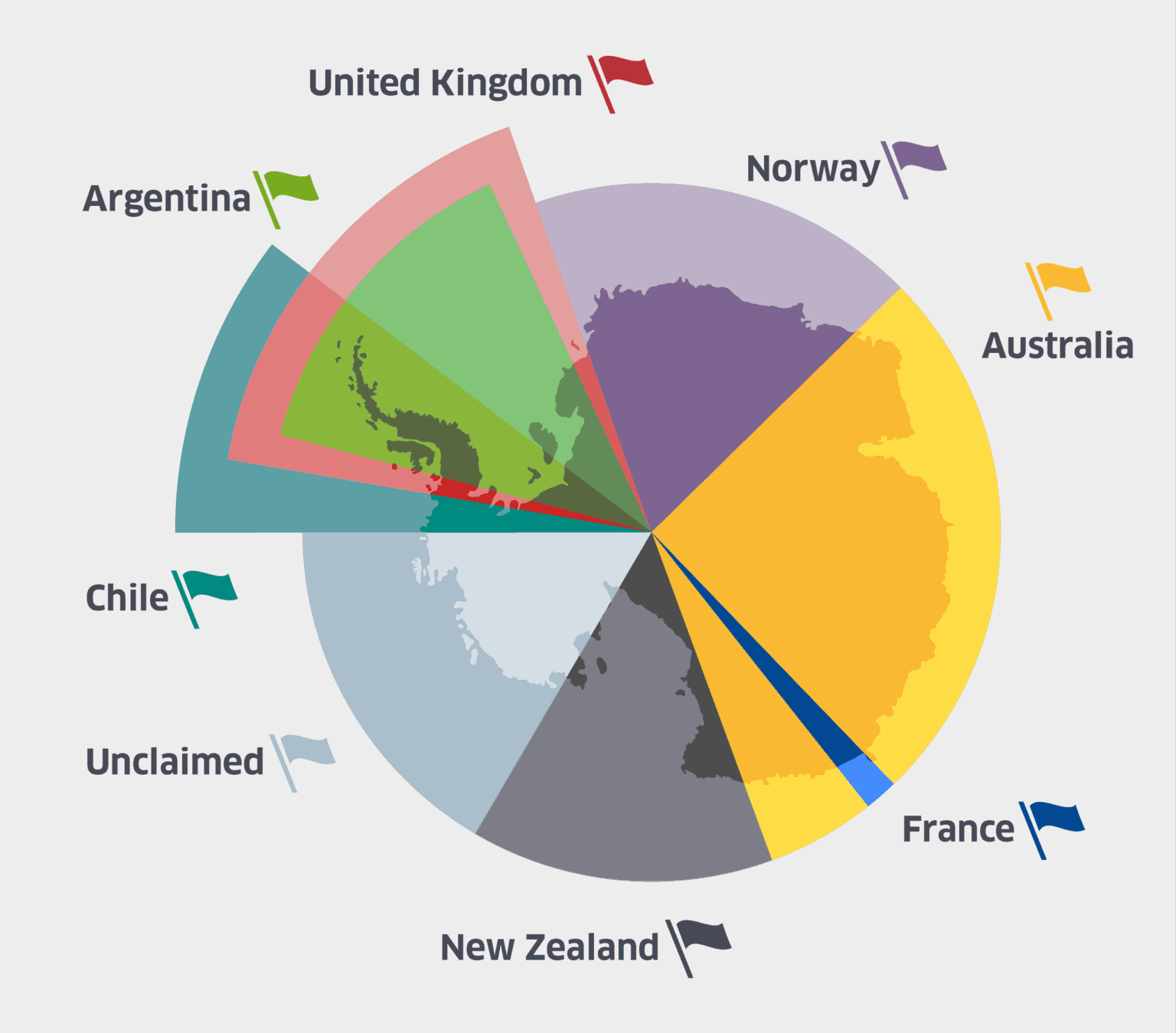
But Argentina and Chile felt more ambitious about the South Pole than their peers, viewing Antarctica as a natural extension of South America. In the 1940s, both countries established overlapping territorial claims — which also overlapped with Britain’s. Argentina even established civilian settlements, most notably at Esperanza Base, which featured housing and a school.
Enter Six.
In the late 1970s, Argentina began arranging for pregnant women to give birth at Esperanza Base, with Emilio Palma’s birth the first to occur there in January 1978. Argentina’s aims spurred Chile to also institute the practice.
On January 24, 1980, Six was born at Esperanza. But it took a miracle.
Six’s father, an Argentine army colonel, was one of the country’s first Antarctic explorers — no GPS, internet, or mobile communication to explore the frozen terrain. Six’s father “was very proud, very Argentinian, very patriotic.” But Six says the colonel didn’t shy away from expressing how exploration efforts posed a significant risk, noting the lack of hospitals, airports, and general infrastructure.
But higher-ups brushed aside the colonel’s concerns; those worries proved correct when a fire damaged the Esperanza Base’s facilities. Luckily, an emergency radio call reached Buenos Aires about a pregnancy complication, connecting despite wintry winds traveling over 200km/h (or ~124mph).
Six’s father, already skeptical of the Argentine junta government’s plan, was upset. He asked the president for help, but was told, “If we are lucky, the help will get there in three months.” So, the colonel improvised.
A 14-person crew flew in on two helicopters and headed toward Esperanza. A journalist who joined the trip to document Argentina’s Antarctic presence rode in a tracked snow vehicle below — but it got stuck in an ice crevasse.
Six’s father relinquished his helicopter seat to the journalist. “From the crew, the only one that have experience in Antarctica was my father,” Six says. “He got a sled — he got the Argentinian polar dogs — and with his sub officer, [he] start[ed] the way to Esperanza Base by Earth in a sled.”
While the colonel’s dogs dashed along the dangerous icy landscape, his wife went into labor early. The clock ticked.
Half an hour… 45 minutes… an hour… an hour and a half…
“My dad did not arrive,” Six says. “My mom got worried. When my father arrived, I was already born — kilo and a half, six months pregnancy. Nowadays, premature babies have a hard time to survive, and I survived in a fire base, without nothing. I mean, I think it's meant to be.”
Of the 11 born in Antarctica, Six is the only one born within the Antarctic British Territory and the only British citizen; he says that, according to British law, the other 10 native Antarcticans also were born within the same territory, but are not British citizens. All of the others were planned births that arrived on time. Six arrived early.
“It’s other 10 native Antarcticans; it’s other seven Argentinian native Antarcticans; it’s other three Chilean native Antarcticans,” he says. “But it’s only one and only British native Antarctican, which is me.”
His mother insisted that it was divine intentions for his birth to happen early, essentially, without any neonatal infrastructure.
“My mom,” Six fondly recalls. “She smiled and she said, ‘Well, I believe that Antarctica has something that it’s difficult to explain with words. Something magical or mystical.’”
“YOU TOOK MY ISLANDS, I’M TAKING YOUR GAME”
IT DOES NOT take long to realize that Six is unapologetically himself. Across each conversation, his voice rises with excitement, he double-checks for clarity (he’s self-conscious of his English, which isn’t bad at all), and smiles a bunch. “The idea,” he cheerfully says of his goal in sharing his story, “is to spread the word and try to come up with a positive message, basically.”
That optimism wasn’t always there. With his father in the Argentine military, Six’s family lived all over the country; “I only spent two months of my life in Antarctica,” he says. “They got the plane and they took me to Argentina.” Growing up, he wanted to and followed in his father’s footsteps, joining the army, too. For most of Six’s early life, Antarctica wasn’t at the forefront of his identity. It was simply the land where he’d be born.
“I would say, until I quit the army,” Six says, “I was 100% Argentinian.”
Argentine identity carries a powerful sense of national pride. It might not be unique to their culture, but it is distinctive. So it makes sense that Six felt so passionate — especially given the political climate at the time that influenced what being Argentine meant.
Two years after Six was born, the Falklands/Malvinas War broke out. Argentina’s military junta, which had seized power in March 1976, invaded the British-controlled islands roughly 300 miles off the coast of Argentina. The regime was losing control and faced mounting civil unrest and criticism, so it banked on seizing the Malvinas as a way to earn favor.
Six’s father was barred from fighting by the Argentine leadership, because, Six says, “he knew that my father will never surrender.” The British recaptured the territory and the conflict ended after 74 days, leaving 649 Argentines, 255 Brits, and 3 Falkland Islanders dead. Protests across Argentina spread in the following days, leading to the end of the junta dictatorship and Argentina restoring democracy in 1983.
But the Falklands/Malvinas War did more than restore democracy — it left a wound with a group of people that takes an exceptional amount of pride in its cultural identity.
“I understand why, because I know Argentinians — I'm Argentinian too,” Six explains. “They feel like [they need] revenge.”
The soccer pitch is where those feelings have played out. Since the conflict, plenty of history has been written about England and Argentina’s clashes.
The first time the teams met in 1966 — the first and only year England’s men have won the World Cup — Argentine defender Antonio Rattín’s dismissal for dissent and police escort off the field helped inspire the introduction of yellow and red cards. But it was what happened in the aftermath of the Falklands/Malvinas conflict that elevated the matchup into an iconic, contentious rivalry.
During the 1986 World Cup in Mexico, only a few years removed from the Malvinas conflict, Diego Maradona scored two quarterfinal goals against England to lift Argentina to a 2-1 win: the “Hand of God” and the “Goal of the Century.” Years later, Maradona would admit, “This was revenge. We all said beforehand that we shouldn’t mix football with the Malvinas, but that was a lie — an absolute lie. We thought about nothing else. It was much more than eliminating England from the World Cup.”
That encounter was encored by a controversial David Beckham red card after a challenge on Diego Simeone in the 1998 World Cup. Then in 2002, David Beckham scored a redemptive, decisive penalty after a foul by Mauricio Pochettino on Michael Owen.
Although the English won the last head-to-head matchup, Argentina has won three World Cups (1978, ‘86, and 2022), earning more notable results than England. “As someone who grew up there,” says Six, who began playing soccer in Argentina at 11 years old, “it’s a religion.” Lionel Messi is widely considered the greatest player of all time, with no British products coming close.
The Argentines love singing “el que no salta es un inglés” which translates to: “He who does not jump is an Englishman.” Revenge — going into Wednesday’s kickoff, at least — has been sweet.
“You took my islands,” Six says of the Argentine mindset, “I’m taking your game.”
“IT IS HOW I FEEL.”
AS ARGENTINA EARNED symbolic vengeance on the pitch, Six began expanding his horizons.
In 2007, Six moved to the United States because he was a member of an international student program. His father had passed away, and his solidified identity began to evolve. “I was very proud about Argentina,” Six says. “I never cared about the rest of the world. My center was Argentina, you know? I really believe I changed for better. I learned when I was 27 that the world was bigger than Argentina, start knowing that people from different parts of the globe, they were similar to me, you know? So I start changing.”
While studying at Hodges University in Fort Myers, Florida, Six’s visa was nearing expiration when he befriended a Texan man named Zach, “my American angel,” who helped him learn about a British law that, because he had been born in the British Antarctic Territory, allowed him to apply for British citizenship.
His Florida friends urged him to avoid London and instead move to Newcastle, noting Argentine defender Fabricio Coloccini played for the city’s Premier League club at the time. (Argentine striker Carlos Tevez was shining for Manchester City at this time, too.)
In 2011, Six moved to Newcastle. “Coming from a military background, knowing about the Malvinas War,” he recalls, wondering, “how the hell they are gonna be treating me? They were super friendly, super polite, and I tried to explain to my Argentinian friends. In Argentina, it’s a big deal. In the U.K., it’s not. It’s one more conflict that they have. They have a war against Argentina, against France, against — how many wars do they have?”
Upon arriving in England, he recalls playing on a pickup soccer team started by a new friend, Henry. The team featured players of Mexican, Colombian, and English descent.
“I think football, or soccer, has something mystical or magical, too,” Six says, “which is getting people together.”
He stayed in England for three months before moving to Spain. But, he says, “my connection to Britain was never about how long I lived there. It’s part of my legal identity.”
Seeing the world softened Six’s heart. It also inspired him to consider and reckon with his identity.
“I'm not half Argentinian and half British,” Six says. “I'm a native Antarctican, 100% completely native Antarctican. Also, I'm Argentinian. Also, I'm British. It's not half and half. It is how I feel.”
“Living between those two worlds,” he later adds, “shaped the way I see identity, football and even friendship.”
Six’s pride is in defiance of what governing bodies across the world fail to recognize. The Antarctic Treaty, signed in 1959 in Washington, D.C., does not address the status of Antarctic-born people because, well, it was written under the assumption that the continent had no permanent or indigenous population. They are granted no distinct political recognition, nor are they granted representation in governance over the continent — that responsibility rests with the Consultative Parties to the Antarctic Treaty.
Six, and other native Antarcticans (who each have numbered nicknames based on their birth order) have formed the Native Antarctican Foundation to raise awareness and dispute that their omission from Antarctic Treaty System leaves them unrecognized.
“Imagine that, to get citizenship, it can be by soil or by blood,” Six explains, “and Argentina and Chile send people to [be] born in a place that they don't have the sovereignty.” Essentially, he argues that the countries tried to game sovereignty rules to their advantage, leaving the resulting human beings, like Six, legally and existentially awkward.
Of course, that awkwardness and subsequent reckoning with identity has made personal life more complicated for Six than perhaps it would be if he’d just been born in Argentina. Ahead of Wednesday’s game, he shared an A.I. graphic of himself wearing a split jersey between Argentina and England.
“First one that comment was my brother, who is part of the armed forces in Argentina,” Six says. “He called me through the phone, ‘What are you doing wearing an English shirt?!’”
While he acknowledges comprehension for why Argentines are not in agreement with his split loyalties, Six’s optimism and hope for people to put aside their differences, within reasonable context, pushes through. He reflects on how inclusive the Beautiful Game is and even how Antarctica is one of the most inclusive environments in the world. He hasn’t returned to Antarctica since leaving at 2 months old. He says he simply hasn’t had the opportunity.
“In Antarctica,” Six explains, “Ukrainians and Russians are not shooting each other, [they] are cooperating. Chileans and Argentinians, or Argentinians and British people, they cooperate.”
“I'm [going to] continue trying to explain that together we are stronger,” he adds. “You know, why we need to split?”
Perhaps Six is meant to always stand within that gap. In the face of an existential paradox, that’s exactly where he seems meant to be.
“I was a baby,” he says. “I just decided to come to this world in that part of the globe. And from the 11, it's the only case that was not planned. I think maybe God put this mission on me, you know?”
Video courtesy of José Manuel Valladares Solis