2026 World Cup: How Iranian Fans Are Reconciling Team Melli, Islamic Republic
“Our people are strong and resolute. We’re very proud, because we know what we come from, and we know that this regime is just a blip in the radar of our history.”

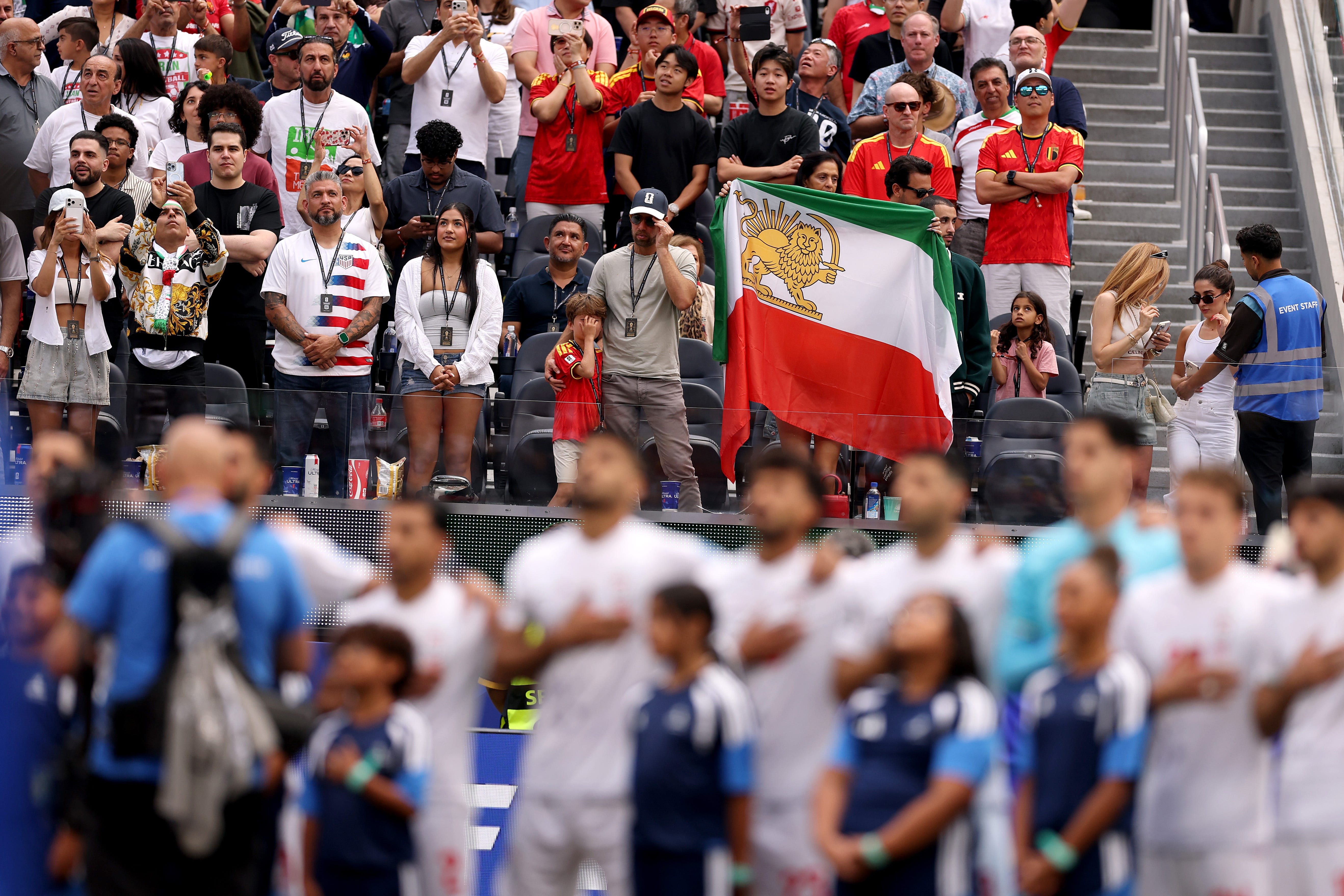
Scoring, in soccer, is precious. When the ball hits the back of the net, there’s a collective expression that instantly captures the yearning and gratitude for experiencing such a fleeting moment. It’s an emotional contagion unique to the beautiful game that’s difficult to name, but impossible to forget. When Iran right back Ramin Rezaeian poked out his right boot and tucked away Team Melli’s first goal of the 2026 FIFA World Cup, that feeling swept through the crowd of 70,108 inside SoFi Stadium, like a wave crashing against the shore.
“It’s kind of unmistakable in soccer or in football,” Iranian-Canadian actor/producer Tara Grammy says, two days after attending Iran’s opening World Cup match against New Zealand in Los Angeles. “That moment when all the Iranians would stand up, it was really, really cool.” Her voice begins to drift. “You forget in those moments, you forget…”
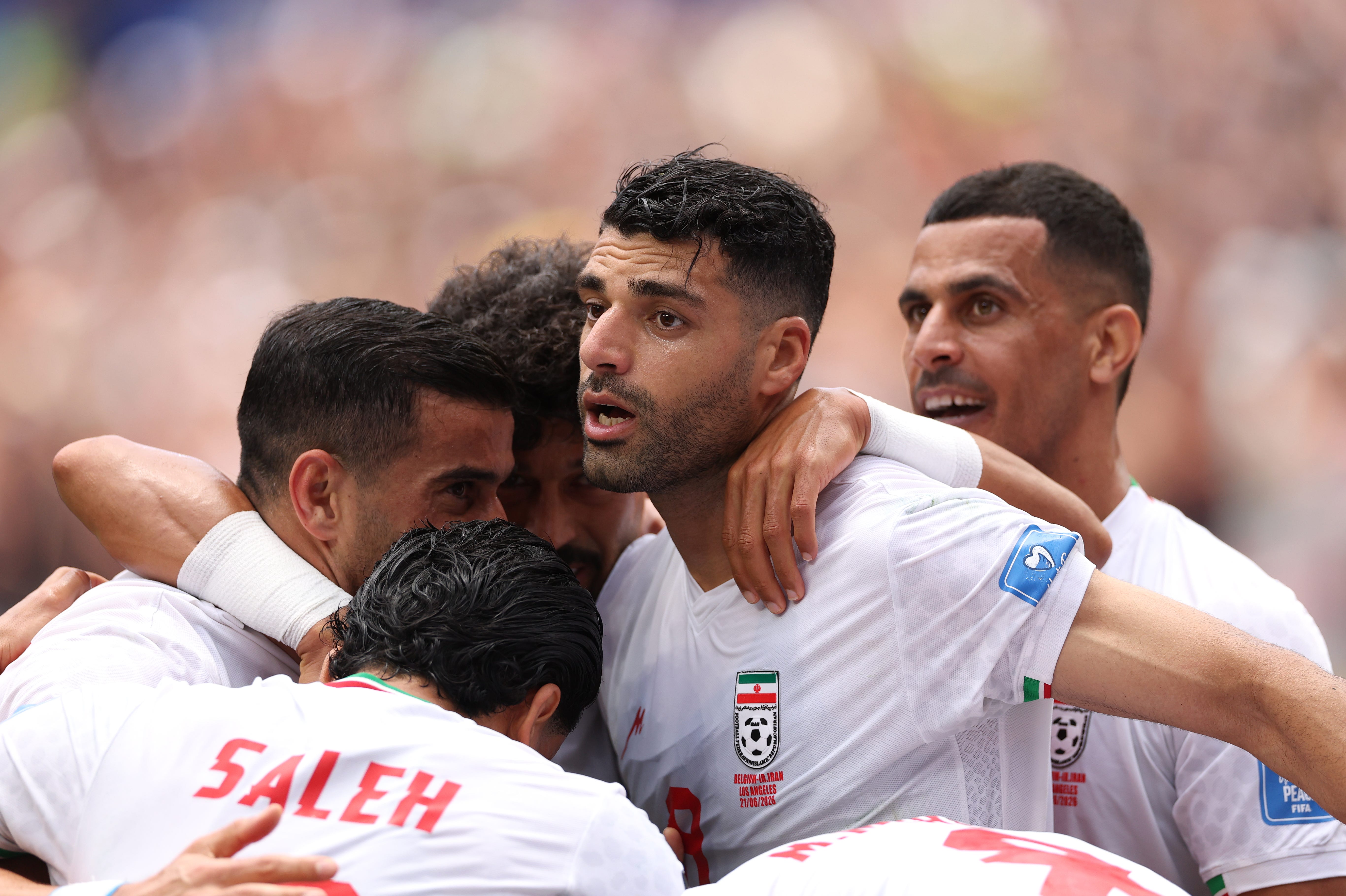
For that moment — and another, if you count midfielder Mohammad Mohebi’s 64th-minute equalizer — Tara and every member of the Iranian diaspora witnessing Iran’s scrappy 2-2 draw could briefly allow themselves to be present, disentangled from the exhaustion over the unrest happening off the pitch back in Iran.
“I was proud with the comeback,” Sina Maghsoodnia, a Persian-American collegiate goalkeeper who also attended the match, says two days later. “But they should have won! They had a lot more chances, they were on the attack a lot more.”
“When Iran scored their first goal, everybody went nuts in the stadium,” Nazanin Nour, an Iranian-American actor/writer and human rights activist, says the morning after. Nazanin and some friends caravanned together, then scattered to different seats around SoFi for the match. “The overwhelming feeling was a pride of being Iranian and wanting to win the game,” she adds. “But also, showing how we felt.”
Iran’s World Cup debut marked the culmination of an unavoidable collision between sport and politics. The weight and tension of the nation’s fraught political situation felt palpable in the buildup to kickoff both inside and outside of the stadium. Here was Iran competing in a World Cup match on United States soil as a war that, hours beforehand, was supposedly ending back home. It’s the first time in history that a World Cup host has received a team it’s actively engaged in war with.
“It’s weird,” Tara says. “I mean, there’s no other word for it. How do you reconcile being a sports fan and being an Iranian? It’s really hard.”
The opening match offered a platform for voices to be raised and heard in space where they could be best publicized and, perhaps, best understood. As Iran’s players took the pitch for warmups there were cheers; during the anthem, plenty of boos (although TV broadcasts drowned them out). Different sections experienced varied interactions. Flags unfurled, backs turned, and eyes cut cold glares. There were tongue-in-cheek mutterings and open bickering — the understandably leery reactions of people seeking resolution triggered by discord sown originally by the hands of invisible powers.
“We’re all on edge,” Tara says. “Especially in the diaspora, and everyone’s suspicious of everyone. Everyone’s calling everyone a regime supporter, calling everyone this, calling everyone that. It’s… it’s tough.”
Members of the Iranian community have spent the past month reconciling with Iran’s men’s national soccer team competing at the World Cup in the United States amid the backdrop of war, unrest, and confusion. While Americans have grown exhausted of the Donald Trump administration’s months-long, haphazard conflict with Iran, the Iranian diaspora has simultaneously dealt with much deeper, more painful feelings regarding the latest iteration of an underlying Islamic Republic regime responsible for numerous human rights abuses against its own citizens across nearly 50 years of power, including the killing of more than 50,000 of its own citizens earlier this calendar year.
In global culture, sport is meant to serve as an escape from the brutal stress of civic failures. And while millions of soccer fans across the world can watch the World Cup with varying levels of detachment, the Iranian diaspora has had to attempt intricate mental gymnastics at making sense of political misgivings that have squarely impacted them and their team. They’ve even had to consider what message rooting for Iran or simply wearing their national team’s jersey might send.
For 90-plus minutes across three games, perhaps mercifully, they’ve been able to put aside conceptual differences and shared emotional pain, and be united as fans simply enjoying the thrill of competition. “Honestly, we had the time of our lives,” Tara exclaims. “I don’t know how else to tell you how much fun it was.”
“It doesn’t mean we root for the government,” Nazanin says. “It just means we want our team to win.”
How to move beyond the Iranian regime’s leadership remains a divisive topic within the diaspora. Nazanin expresses understanding for all perspectives, even those she might not agree with. “Everybody’s feelings are valid,” she says, “and they all stem from pain and trauma and love for country.” It’s in the very face of that emotional dissonance that she’s found reason to allow herself to root for Team Melli. “I’m not,” she says, “going to let this regime take away my joy and my pride in being Iranian, and being able to celebrate something that should be joyous and unifying.”
That pride underscored her motivation the night before Iran played New Zealand. At around 7 p.m., Nazanin surfed last-minute ticket listings with the excitement she held as a child watching Team Melli on TV with her father and sister during the 1998 World Cup. On that June afternoon, inside an Irish bar in Arlington, Va. full of United States fans, Nazanin and her family, sporting Iran team kits, were the only ones celebrating as Iran, then competing in its first World Cup in 20 years, defeated the USMNT, 2-1, in a match dubbed “the mother of all games” between the two estranged countries.
Since then, Iran has only missed World Cup qualification once (2002). However, just as consistent as Iran’s tournament appearances are its concurrent political entanglements or issues that make it almost impossible for supporters to not feel conflicted.
Last year, when tickets dropped for Iran’s matches in Los Angeles — known as “Tehrangeles” for being home to the largest population of Iranians in the world outside of Iran — Tara and her husband couldn’t resist. “‘Once in a lifetime, Iran’s playing, we gotta go!’” Tara remembers thinking. “We got tickets — and they were stupid expensive, but we’re like, you know, eff it.
“Then everything went to shit.”
On December 28, 2025, Tehran’s Grand Bazaar (described as “the economic barometer of Iran”) found itself engulfed in strikes and protests after the collapse of the rial, Iran’s national currency, against the dollar. Soaring inflation had left perturbed shopkeepers and merchants unable to purchase goods. Ordinary citizens and laborers joined their protests, with uprisings occurring across all 31 Iranian provinces, including 111 cities and towns. The crowds progressed in calling out, not only for economic repair, but for total regime change, posing the biggest threat to the Islamic Republic since its 1979 inception.
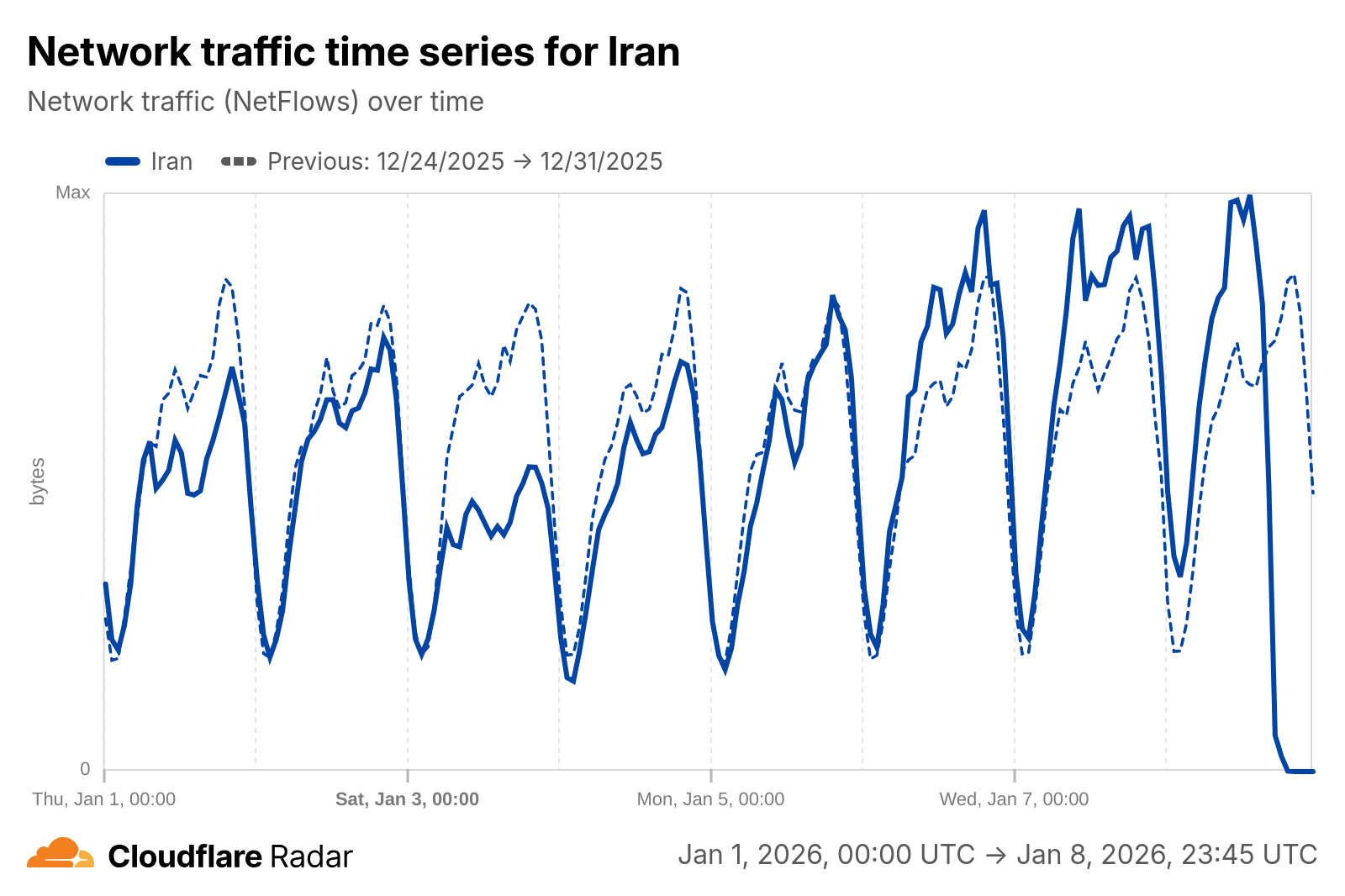
On January 8, 2026, Iran’s government cracked down, staging a total, nationwide internet blackout to isolate the country, and its 90 million citizens, from the global internet — specifically the west, to avoid instigating demonstrations. Telephone lines and SMS services were cut, too. People tried connecting to Starlink terminals, something already criminalized under the current regime, punishable by death.
From within those shadows, the Islamic Republic regime — responsible for the highest rate of executions in the world — carried out its evil against its own people. Rooftop snipers. Tactical vehicles armed with heavy machine guns. Bird shots. Machetes. Batons.
As many as 30,000 people were killed by regime servicemen in the streets of Iran on January 8 and 9 alone.
30,000 people.
By January 24, that figure rose to an estimated 50,000, including 300,000 wounded.
“Same playbook,” Nazanin says of the regime’s horrifying, routine tactics. “Turn off the internet, massacre, and slaughter.”
The administration ran out of body bags. Security forces entered medical facilities to detain injured protestors, a tactic used to scare the wounded from receiving medical care. The regime blocked burials and seized bodies, denying families the right to mourn. According to TIME, the only comparable recorded massacre occurred during the Holocaust, on September 29 and 30, 1941, when Nazi death squads executed over 33,000 Ukrainian Jews by gunshot in the Babyn Yar ravine.
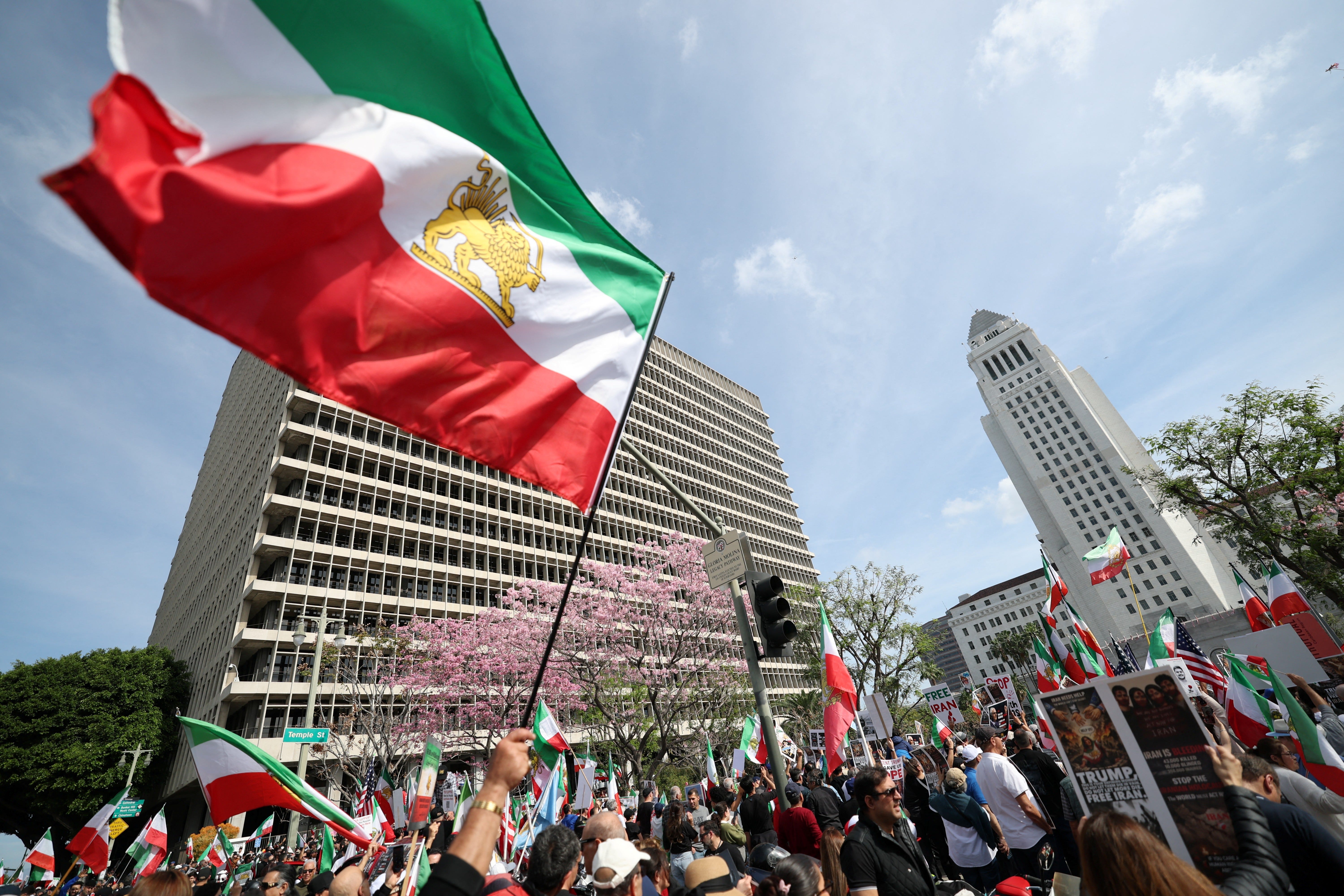
On February 7, thousands in Berlin, Germany, gathered to protest in support of the Iranian uprising. A week later, on February 14, thousands gathered in downtown Los Angeles to protest the Islamic Republic’s regime, calling for the United States to show support and solidarity with the people.
“I just want people to believe Iranians and amplify Iranian voices,” Nazanin says. “Believe you can be anti-U.S. foreign policy, you can be anti-imperialism, you can also be anti-Islamic Republic. That’s what I hope more people start understanding and practicing, and not just holding it as a theory.”
Esfandiar, an author, grew up obsessed, intertwined with the world of soccer. At 6 years old, he watched as Iran won the 1990 Asian Games in Beijing. A former halfback (a position today known as defensive midfielder or a No. 6), Esfand had dreams of playing professionally. He still remembers constantly seeing members of the local pro team walking around his hometown of Mashhad, a northeastern Iranian city. “At that time,” he says, “football was more connected to our daily life.”
Soccer is the biggest sport in Iran, rivaled only by wrestling, which traditionally has carried more importance. He moved to the United States over a decade ago. The World Cup being announced in North America — and the chance to potentially see Iran play in the tournament — should have been a means for celebration.
“None of my friends [are] talking about the World Cup,” Esfand insists over the phone in late May, a few weeks before the World Cup kicked off. “I’m talking a bunch of people, like 15, 20. None of them! Nobody even thinking about it.”
On February 28, the United States and Israel launched coordinated, large-scale airstrikes against Iran, unleashing 900 strikes over 12 hours. Trump followed through on threats to intervene if Iran’s regime brutalized its citizens, while Israel said its objective was to deter the Iranian regime from building nuclear capabilities. Iran’s Supreme Leader Ayatollah Ali Khameni, who’d been in power since 1989, was killed in the strikes. But the path forward remained unclear; instead of resolution, Trump and the United States instead spent months seemingly more concerned with controlling the Strait of Hormuz than aiding the Iranian citizens Trump had claimed he’d rescue. The day after the U.S.-Israel strikes, Mehdi Taj, president of Iran’s soccer federation, told Varzesh3. “What is certain is that after this attack, we cannot be expected to look forward to the World Cup with hope.”
For Iranian supporters, there’s a tinge of this hopelessness hovering over the buildup to the tournament seemingly every cycle. Ahead of the 2022 World Cup in Qatar, the Women, Life, Freedom movement commenced in September. Mahsa Amini, a 22-year-old woman from Iran’s Kurdistan province, died while in custody of “morality police.” She’d been apprehended for breaking Iran’s dress code for women by not wearing her hijab properly. Widespread protests carried through into November, with demonstrators appearing outside of Iran’s matches.
“I couldn’t even support the national team, to be honest, especially during that moment,” Esfand says. It’s clear that he’s still, understandably, in pain, as if emotional wounds are still fresh. There’s also a hint of weariness at the appalling nature of the regime’s cruel tactics.
“After [the] Qatar World Cup,” he says, “football is gone for me.”
The regime’s actions following this year’s massacres furthered his disillusionment. Iran’s domestic soccer leagues resumed play in late January, but did so in empty stadiums — a tactic suppressing any chance at the people using domestic games as a platform for protest. “They basically killed this emotion,” Esfand explains, “because they are scared [of] — really scared — thousands [of] people gathering together in the middle of the city. It definitely has a potential to be a protest easily.” Players looked expressionless during games. The Persian Gulf Pro League — Iran’s top-flight men’s soccer division — only suspended play once the war with the United States broke out. Seventeen players on Iran’s 26-man World Cup roster hadn’t played regular games since February as a result.
There’s a clear level of sympathy for the position the players find themselves in. Many expect them to raise awareness to the Islamic Republic’s ruthless actions. “There’s this part of me, because I’m an artist, I kind of understand how hard these players work their entire lives,” Tara says. “This is their dream and they’re from the same soil as I’m from. How do I know how I would react if I was raised in that society, and under all of that pressure, and then have this big goal? I don’t know how I’d react, so there’s a bit of compassion that I have for them, just as human beings.”
“It’s understandable that people want others to step in and influence where they can, because of how hard life is over there right now,” Sina adds. “But they’re football players. Let them play football. Like, you don’t have to be angry at them for not making it political, in my opinion.”
When asked if people felt the national team represented the Iranian people, the government, or something in between, most land in between. Tehran Von Ghasri, a Black-Persian comedian whose father is from Iran, explains that confusion over trying to answer this question is something “every Iranian is feeling” this summer.
“Some are on one extreme, and some are on the other,” Tehran says. “But most Iranians are just feeling that in between, where it’s just, you just don’t know. That feeling has made a lot of people lose composure. It’s frustration. It’s bitterness. It’s anger. It’s all the things, and it’s targeted towards players. I wish things were different. I wish that I too could be as proud of the team of my father’s national origin as I see other countrymen are of theirs.”
“A lot of people don’t see them as the national team right now,” Nazanin says, “because they think they’re controlled. The government or the regime has their hands in everything — which they do — and they try to control the narrative with athletes, and they do use them to their benefit for PR.”
There are multiple instances of the Iranian government intimidating and killing athletes. During the 2022 Qatar World Cup, families were threatened with imprisonment and torture if players failed to behave after some players refused to sing the national anthem or protested the regime. Earlier this year in March, five members of the women’s national team refused to sing the anthem during an Asia Cup match; Australia granted them asylum. During the regime’s crackdown in January, Saleh Mohammadi, a 19-year-old national team wrestler, was executed in a public hanging after being found guilty of killing two police officers and moharebeh (waging war against God), the latter of which results in death sentences for protesters and the regime’s opponents. Two young wrestling champions — Parsa Lorestani, 15, and Irfan Kari, 20 — were also killed by their government during the January protests.
“When the government executed them,” Esfand says, “they not just killed them, they basically killed the hope.”
When the Iranian men’s soccer team arrived in Los Angeles ahead of its World Cup opener, players wore “#168” and “#Minab” pins to commemorate the lives of the 168 Minab elementary school kids killed by a missile strike on the first day of the U.S.-Iran conflict. But there hasn’t been any outward demonstrations pointed at the regime — at least not anything obvious. Some expressed great appreciation for the players wearing the pins condemning the United States’ heinous act. But Iranians wonder if, given the clear risk, there will be any condemnation of the regime.
“That shows that their speech is stifled or that the government wouldn’t let them do that, even if they wanted to,” Nazanin says. “So that’s what bothers people, is that double standard. It’s like, yeah, show that we should always hold people responsible for that war crime. But also, we should hold the Islamic Republic responsible for their crimes against humanity and war crimes. That’s also why it makes it difficult for some people to root for the team, because they see that they’re being used as propaganda by the regime as well.”
Processing these complications are what make rooting for the Iranian national team such a challenge across the diaspora. And while there may be changes for many, depending on what’s happening with the regime, there’s a sense of loyalty present in some form.
“While my affinity for the team isn’t the same, my true feelings of pride will never allow me to root against Iran,” Tehran says. “So, I see a lot of people rooting for the opposite team, and I just don’t have that in me. I’m not built like that. I will always root against the Islamic Republic regime, but I can never root against Iran or the Iranian people. They are not one in the same.
“With sports, just like always, politics just becomes commingled.”
Standing in the middle of everything are 26 men experiencing the dream of every professional soccer player. With that, they are shouldering the weight of their peoples’ emotional exhaust and political angst, plus navigating under the lingering watch of an oppressive regime. All of that is stacked atop the personal pressure of performing on world football’s biggest stage.
“If you take a break, take a step back, they’re just people, too,” Sina says. “And it’s up to them whether they want to advocate politically about something, share their opinions on something. In the end, it’s just a job. Like, yes, you have social standing by being popular, but it’s up to the person to — if they want to — step in the limelight or not, because then that becomes their life as well.”
It’s been quite a journey for the Iranian men’s soccer team. On March 25, 2025, Team Melli became the first nation to qualify for the 2026 World Cup, marking its fourth straight appearance. Qualifying proved to be the smoothest part of the ride; by the end of the year, warning signs for an uneven road became apparent. In late November, Iran boycotted the World Cup draw hosted in the United States, citing visa denials — including one for Mehdi Taj, the soccer federation’s president. But a few days later, national team head coach Ardeshir Amir Ghalenoei and a delegation arrived in Washington, D.C. for the draw, which placed Iran in Group G with Belgium, New Zealand, and Egypt.
Then, the January massacres occurred. Amid the turmoil, the Kino Sports Complex — home of FC Tucson in Arizona — was chosen as Team Melli’s home base for the World Cup. A week later, the U.S. conflict began. Trump told reporters, “I really don’t care” if Iran plays in the World Cup. FIFA President Gianni Infantino spoke with Trump and claimed the President had assured him the Iranian team would be welcomed for the competition, but the next day, Trump said he didn’t believe it was “appropriate” for Iran to participate. He suggested it could be a risk to the players’ “own life and safety.”
“Certainly,” a statement in response from Iran’s team read, “no one can exclude Iran’s national team from the World Cup; the only country that could be excluded is one that merely carries the title of ‘host’ yet lacks the ability to provide security for the teams participating in this global event.” Talks to move Iran’s base camp to Mexico kickstarted shortly after, although it wasn’t until mid-May, less than a month before the World Cup started, that an agreement to house the team in Tijuana was reached. Meanwhile, Trump escalated the war, specifically in the Strait of Hormuz, where 20 million barrels of crude oil and petroleum products pass through daily (or over $600 billion in annual energy trade). On June 1, 2026, Iran finalized its World Cup roster — star striker Sardar Azmoun, the nation’s second-leading all-time scorer, was left out after expulsion from the national team for posting a picture on social media with Dubai ruler Mohammed bin Rashid Al Maktoum.
So many of those issues would foreshadow the obstructions the Iranian team would deal with once the tournament kicked off. Due to travel restrictions, Iran was only allowed to travel the day before their matches, flying up from Tijuana to Los Angeles for its first two games, then immediately flown home afterward. Sina, who spent four years in Serie A giants Juventus’ youth academy, explains that the hasty itinerary put Iran, which has already had minimal on-field experience this year, at a disadvantage. “The buildup to game day is more important than game day,” Sina says. “Like, preparing yourself for the day leaves you prepared for the day. Restricting us from being able to do that is just like that’s like they’re literally preparing us to lose. So it’s really a fight of honor, I’d say, [for] the Iranian national team to show that, even with all these setbacks, we can still perform. So I just hope they do.”
Mexico welcomed the Iranian team with open arms. That hospitality thankfully extended to members of the coaching staff who couldn’t travel with the team to Los Angeles for the first match against New Zealand. “They’re fighting from a point of instability off the rip,” Sina says. “I think all the restrictions — just, like, how the [U.S.] government has done to our government, like sanctions and such — it’s keeping the team down, and it’s making them fight from an underdog position. That’s really hard.”
While there have been many positive reasons to celebrate widespread, welcoming moments of cultural exchange amid what some are referring to as “The Diaspora World Cup,” Iran’s experience serves as a template for the exact opposite. After Iran’s opener against New Zealand, forward Mehdi Torabi’s single-use visa expired (the rest of the team had received multiple-entry visas), leaving his status for the remainder of the tournament in doubt before he was issued a new one.
“Everything,” striker Mehdi Taremi, the Iranian team captain, said, “is like a disaster, actually, for us.” He would add: “We don’t have support and I think FIFA has to help us more than this.”
Of course, Iran isn’t the lone team to experience visa issues or have its travel plans strangely hampered. But Iran’s head coach senses a heightened level of mistreatment. “Our team,” Ghalenoei told reporters through an interpreter, “is the most oppressed one in the whole World Cup.”
“It’s gotta be weird for the players to be in a country that just bombed your homeland and that you have friction with,” Nazanin says. She points to the discriminatory, unfair nature of how the U.S. government would quickly ferry Iran back to its team base, but notes that the inconvenient itinerary is nothing compared to those in Iran under oppression and risking their lives. “I think all of us should be able to hold those multiple truths and not see everything as just black and white,” she says. “And I find that most people can hold the multiple truths — it’s just that the loudest voices are the ones that get the most attention, and those are always going to be the most extreme from anything, whether it’s American politics, Iranian politics, etc.”
Some of the loudest opposers of the Islamic Republic have made their presence known at Iran’s matches by waving the lion and sun flag. The flag became a major talking point, not only at the World Cup, but within the diaspora as it reckons with how to move forward. Iran is one of the oldest countries in the world, with the land bearing over 5,000 years of history. Over 2,000 years ago, the region first unified as a nation in 625 BC, and the Persian Empire first emerged in 550 BC. In 1935, Reza Shah Pahlavi ushered the land’s name change to Iran, as recognized today. The lion and sun flag represented monarchical Iran until 1979, when the Islamic Republic was formed. The regime’s current flag has an Arabic scripture in the middle. “The exiled Crown Prince (Reza Pahlavi), the son of the last shah of Iran,” Nazanin explains, “had issued a call to action [in January, urging] Iranians take to the streets, come out on the 8th and the 9th, and show your support for wanting the regime gone.”
FIFA ultimately banned the sun and lion flag from being flown during Iran’s matches. While FOX broadcasts have avoided displaying fans waving them in the stands, plenty of them, including Nazanin, have found a way to get them into stadiums.
“For me raising that lion and sun was telling FIFA, ‘You can’t tell people that they can’t be proud of their culture and bring the symbol in,’” Nazanin says. “People in Iran died hoisting the lion and sun up during the January protest and massacre. That’s the easiest form of protest and act of solidarity I can show.”
Tehran researched and learned that FIFA only permits the current official national flags of participating countries. “But,” he says, “I would say this to FIFA: I understand where you’re coming from, but you need to understand where the people are coming from. This is a very unique moment in time and in history… this is one of those times where these kind of rules need to go out the window, because it’s not one size fits all. There’s no size that fits this.”
That flag issue informs the other one entangling Team Melli — ahead of their group-stage finale, both Egypt and Iran complained about playing in Seattle the same night as planned celebrations for LGBTQ+ Pride. Same-sex relations are illegal in the Islamic Republic.
“We respect all of the LGBT people,” Taremi told reporters after the match. “That’s their own idea. It’s not about us. We are here to play football. We respect all of those guys.”
Nazanin envisions a day in her lifetime where the regime’s punitive laws no longer restrict her people’s way of life.
“We have thousands of years of history,” Nazanin says. “They’ve only been around for 47 years. They’re not going to be around for that much longer… It might not be today, but it’s going to be sometime in my lifetime. I believe so. They’re going to fall.”
Following an engrossing scoreless draw against Belgium at SoFi Stadium last Sunday, Team Melli left a handwritten note in the locker room:
From the ancient Persia of thousands of years ago to the civilised Iran of today, the spirit of Iran remains alive and steadfast.
We came to Los Angeles with pride, competed with honour, and leave with dignity.
Thank you, Los Angeles, for your hospitality. And thank you to every Iranian who gave their heart, voice, and soul for Iran throughout these 180 minutes.
May peace, respect, and friendship prevail among all nations.
The note, written in blue ink, also included a pair of hearts, along with red #168 and #Minab — further acknowledgment of the February 28 missile strike on the Shajarah Tayyebeh Girls’ School that left 168 dead.
Despite unfair treatment concerning visas and inconvenient travel itineraries, Team Melli expressed thankfulness as it departed Tehrangeles. The team’s note led evening newscasts. But the team’s display of gratitude isn’t the only impression that the Iranian community hopes that people take away from the team’s World Cup campaign. Everyone expressed hope for further understanding and compassion for the diaspora’s current state.
“I hope they use their cutie little fingers, and go online and learn about what’s happening in Iran and why is it that everyone’s so up in arms,” Tara, taking a mother’s warmly instructive tone, urges. “I hope it inspires them to learn more about the people of Iran, and what they’ve been going through, and the experience of being Iranian.”
Adds Tehran: “What I hope is awareness. That people go out and research and understand where the source of frustration and the causation of all this anger is, learn more about the atrocities of the Islamic Republic regime and how much of a criminal enterprise it is and how they have hijacked an entire nation.”
“I just want people to have empathy,” Nazanin says, “and understand more about the evils of the regime and the repression and that the people of Iran are resilient and smart and talented — and their talent and voice is always restricted by this regime.”
That resilience pulled Iran back on Friday against Egypt in Seattle’s Lumen Field. Iran went down 1-0 within the match’s first five minutes, then suffered heartbreak when Taremi missed a penalty. But there, once again, was right back Ramin Rezaeian — the 36-year-old smashed in a close-range finish to tie the score.
Then, in stoppage time, an Iran free kick bounced around the box. Center back Shoja Khalilzadeh thought he’d won it — until VAR ruled him offside by mere inches. It might not have counted, but the feeling did — the same collective surge that swept through SoFi last week. Regardless, Friday’s 1-1 draw against Mo Salah’s Egypt means Team Melli is on the cusp of becoming the first Iranian squad to reach the World Cup knockout rounds.
“My passion for the team has only [grown] more,” Sina proudly said after Iran’s World Cup campaign started, “because it’s like one of the only representatives of us right now in the world that’s not in a super negative light.”
“Our people are strong and resolute,” Nazanin says. “We’re very proud, because we know what we come from, and we know that this regime is just a blip in the radar of our history.”