What GeoSports and 82-0 Reveal About the Future of Sports Fandom
GeoSports and 82-0 restore a sense of communal sports participation at a time when traditional communal sports media has fragmented.

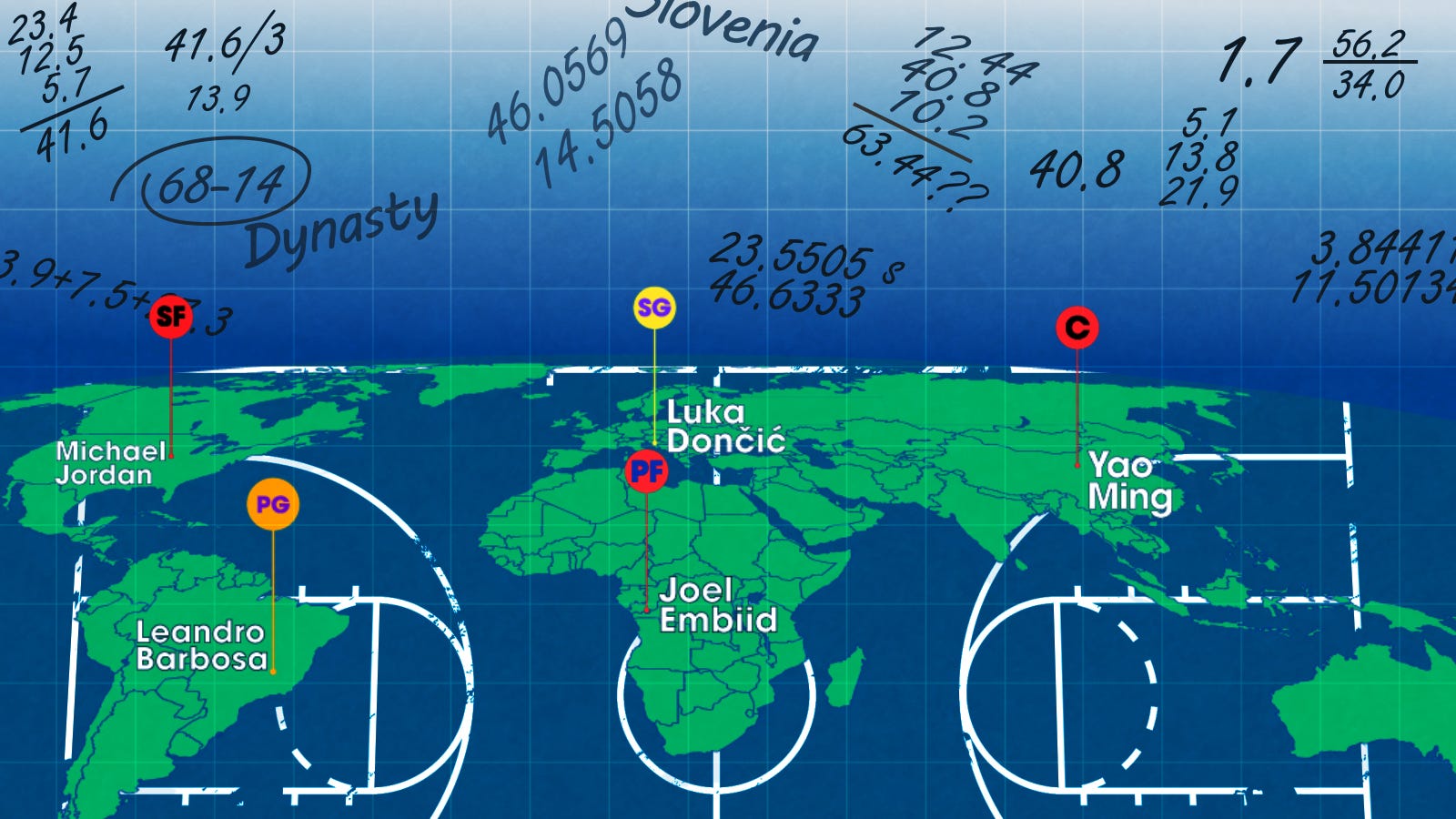
As spring gave way to summer and the American sports calendar crept toward its annual lull, group chats around the country exploded.
First came GeoSports. In May, the daily sports geography trivia game went viral on Twitter/X, earning more than 150,000 single daily users just one week after launch. Then, as the NBA Finals tipped off in early June, 82-0, a stat-based, NBA roster-building game, went viral.
“You play it, usually, by yourself,” Frank Michael Smith, creator of GeoSports says. “However, it’s actually a multiplayer game in disguise.”
Former NFL coach Jon Gruden squinted through a five-minute round of GeoSports — “a great mental game,” he lauded. Indiana Pacers star Tyrese Haliburton crumbled online at his 82-0 lineup falling short of perfection; 10 days later, the iconic Inside the NBA crew signed off their season by playing a round on-air.
The rapid rise of both online browser games magnified the growing appetite for sports content that incorporates fan participation rather than solely observation.
“We want to build a very large community of sports fans,” Bar Almog, CEO of PlayVault, an Israeli gaming company powering 82-0, says. “I think that's what's most exciting about this thing, to take the most classic debates in the world and turn it into something that you know every sports fan in the world can enjoy.”
Everything that 82-0, created by software engineer and NBA superfan Roy Saar, and GeoSports have accomplished is a strong reflection of how sports remain a communal service, even in a hyper-fragmented content landscape.
Community and word of mouth turned a pair of solitary games into a shared experience, sparking debate and competition among hundreds of thousands.
For these browser-based games, there are no email campaigns or push notifications. “This game,” Smith says of GeoSports, “is only really living on X threads and in group chats. Those are both very social functions.”
“I think that's why the community play here is very, very strong,” Almog says of 82-0. “There are no strings attached. You don't have to do something special in order to play, but you can come back and go whenever you want. I think that's what makes it so, so special.”
DOCTOR DANIEL T. Durbin’s first job was on a newspaper’s sports desk. He dabbled in radio and in news, too, but the media market in Los Angeles “was insane.” So instead, he pursued a Ph.D in classical rhetoric at the University of Southern California. The itch for sport never went away. Sport’s role as a public, communal act of shared engagement and narrative maintained his interest.
In July 2009, he proposed that USC create the Annenberg Institute for Sports, Media, & Society, where he’s currently the director.
In his opinion, games like 82-0 and GeoSports are more significant and impactful than credited. “We think of them as just being games,” Durbin says. “These become life for people, and they become as important as sport.”
Sport, Durbin explains, is a fundamental and essential part of culture and human psychology. And narrative, since Pheidippides ran the first marathon in ancient Greece, has always been baked into sport.
“We need sport,” he says, “and every culture that has ever existed has needed sport. Sport is definably a public activity that is engaged in public communication. There’s performance at the center of it, but there are rules that set up the performance, and then there’s public communication that gives meaning to the performance. All sports really exist in the stories — not in simply the act, but the act that is reconstructed as a story.”
This is the hook for sports fans at every level. Sports games allow the spectator to become the player — the main character of the arc, actively the hero or villain of the narrative — making it a meaningful experience in its own right.
For GeoSports, 82-0, and fantasy sports, performance exists within the statistics, allowing spectators-turned-players to recreate a new story out of it, a story that fosters assembly and becomes sport.
“I think they play a pretty important role in building community,” Smith says. “It sparks conversation, you know? Also, what’s the use of watching all these sports all the time if you can’t put this ball knowledge to the test? All dudes like to sit around and be like, ‘Where’d he go to school?’ This is kind of like the next level of that.”
Smith came up with the idea for GeoSports while playing Map Tap, a daily geography game, with family and friends. “I was like, ‘What if I added a sports trivia twist to this, where you had to figure out the answer to the sports trivia question, and then you had to know the geographical location as well?’” he recalls thinking. He played around with some coding on Claude and made a playable version. “Got it out there, and the internet did the rest,” he says. “Really, I did not expect it to blow up so fast, but here we are.”
Before GeoSports and 82-0, Immaculate Grid, a daily sports trivia game featuring a 3x3 grid, swept the internet in 2023. And before group chats became a normalized texting format, Sporcle, which emerged in 2007, had been a longtime online favorite for sports junkies testing their acumen. Where 82-0 and GeoSports are distinct from the others is the additional social elements: There are scores, streaks, and daily resets to restart group chat debates every day.
Fantasy sports, however, set the blueprint for today’s browser-based games. Fantasy goes back well before the internet started and stands at the center of the intersection of competition, storytelling, statistics, and community.
“They create the opportunity to create these sports stories that have the legitimacy of numbers, but they have the narrative of accomplishment, success, failure, championships, and all the other things that we identify with sport,” Durbin says. “The people who join in these communities can gather around these stories, and it’s the same stories: Winning and losing, accomplishment, failure, wise choices in the athletes that you pick, bad choices in the athletes picked, and so forth.”
Back in the early 1990s and early 2000s, Durbin urged others to invest in fantasy sports, which, he admits, “was a bit more dicey … a much bigger risk at the time” compared to the Apple stock he was putting money into.
“You could see that fantasy sports were just going to dominate,” Durbin says, “because they create such a powerful community, and a community that is played as if it is the sport.”
Today, that level of community carries import. Society, despite global connectivity, is more fragmented than ever. Isolation is not just an anecdotal concern, but a widespread, data-confirmed crisis. These trends of division have also polluted the sporting ecosystem, namely broadcasting.
In the past, audiences gathered around one shared broadcast. Now, fans are stretched across streaming services, regional networks, and exclusive rights deals that fatten the pockets of league and media executives at the viewership’s expense. Shared sports culture has become increasingly reliant on a handful of tentpole events, some of which feature draws unrelated to sport to garner attention from mass audiences (ex: Bad Bunny’s Super Bowl halftime show). It’s become less common for American sports fans to watch and discuss the same games at the same time.
The Super Bowl illustrates both the power of shared experience and how rare it has become. By the 1980s, the NFL had built the Super Bowl into an unofficial American holiday for everyone to get together. By the 2000s, more groceries sold during Super Bowl week than any other on the calendar. The league and Monday Night Football rose to prominence, in large part, by building around the dysfunction in the booth between Howard Cosell, “Dandy” Don Meredith, and Frank Gifford, three broadcasters with contrasting personalities. “It made it must-see TV,” Durbin says. “You had to watch to see what the latest thing Howard Cosell was going to say, and the latest way Dandy Don Meredith was going to pop his bubble.” The reactions and discussions about them became an extension of sport living within society.
Over the years, ESPN became the central sports television hub. But as cord-cutting and streaming services emerged in the late 2000s and early 2010s, the hub began disintegrating, and casual fans fell by the wayside. “At that time, you couldn’t yet quite see the complete breakdown of the power of major networks in the United States,” Durbin says, “and major networks kind of defining what our communal sport experience was.”
“I grew up watching SportsCenter every morning,” Smith says. “I grew up watching PTI, Around the Horn, SportsNation. It seemed like it was going to last forever, and I don't know… There's just new versions of it now.”
Personality-driven content, especially after the start of the COVID-19 pandemic in 2020, has helped fill the vacuum that the decentralization of sports content has created. Creators have built armies of supporters, taking their own swaths of fans that, a decade or so ago, wouldn’t have had to seek them out. For example, Smith boasts over 1.4 million YouTube subscribers and 1.9 million TikTok followers.
“I think fans are accustomed now to need things immediately,” Smith says of the modern sports content landscape. “I'm not going to wait until PTI tomorrow to hear Mike (Wilbon) and Tony (Kornheiser) debate, ‘What's the problem with the Spurs? What do they need to do in Game 2?’ It's like you're going to get that almost as soon as the game ends on all the short-form feeds, so immediacy is the biggest thing.”
GeoSports and 82-0 may not create the mass live audiences of sports on cable television. But they offer shared experiences, generating thousands of gathering places over texts and social media that are built around the same daily prompt.
“With all this fragmentation, people are looking for a sense of community or for sport that they can engage in,” Durbin says. “You can more actively engage in sports conversation and sports enactment when you play these games.”
ALMOG AND ROY Saar are longtime friends. Based in Israel, they have to wake up between 2 a.m. and 4 a.m. locally to catch NBA games. “It’s hard when you have young children to keep up with,” Almog jokes.
When Saar’s 82-0 creation gained traction, he sought Almog, whose company, PlayVault, specializes in puzzles and strategy games. They chatted and Almog agreed to help scale it.
“It started off as a cool project for friends and family with a brilliant idea,” Almog says. “Sometimes the best ideas start off as something that you don’t even think how big they could possibly become, and this is what I think is most beautiful about this whole thing.”
Non-sports entities are growing increasingly aware of sports’ draw, too. As Front Office Sports’ Ellyn Briggs wrote in her May piece titled “Is Sports Coverage the Solution to ‘Google Zero’?,” Vanity Fair’s sports issue earlier this year “underscores a broader shift impacting all media brands” with regard to storytelling.
Content houses are going where stable community is.
Sport is one of culture’s last shared languages and can open the door to different elements of culture, such as celebrity, politics, economics, travel, and fashion. Sport is narrative unto itself, whether expressed in a documentary, a magazine profile, or a web-browser trivia game. The success of GeoSports and 82-0 suggests fans aren’t just looking for more content; they want new ways to participate in sports’ narratives.
Sport remains one of the few things millions experience together. (The 2026 World Cup, generating record viewership numbers, is a great example of how sports are capable of bringing together people who wouldn’t typically consume them.)
“Sport exists in the storytelling,” Durbin says. “How do you tell stories when you don’t have the central story?”
Today, media widely lacks communal experiences that occurred when everyone was watching the same television shows every night. Despite the fracturing that’s occurred in the streaming era, people are desperate for community. Sport, more than any other realm of culture, offers shared rituals.
“We have a mission right now of creating these type of games with a lot of depth to make it very, very fun and create a very unique ecosystem around sports,” Almog says. “We are kind of in the intersection of new genre that is rising right now. We want to double down on that and build a very large community of sport fans.”
As people search for a sense of community and sports conversation that they can actively engage in, these games provide that space.
“What sport offers is a community where you can celebrate achievement, accomplishment, championships,” Durbin says. “Where you can agree in pain over failures, where you can always hope to work through your failures to get to some sort of success.
“That’s all community engagement, and these games offer the opportunity to create that kind of engagement, where, to a great degree, it just doesn’t exist anymore in culture.”